
The AMACC Research Platform supports academic and industrial partners in their projects in fine chemicals, healthcare chemicals, and environment and green energy.
The AMaCC platform offers its expertise in the following areas :
The platform has different techniques to help in the structural identification of molecules:
- Exact mass measurement in high resolution ESI, APCI, ASAP (solid introduction probe) of parent ions;
- MS² with high-resolution accurate mass measurement of fragment ions;
- GC-MS (electronic ionization) with database search (NIST).
The platform can also contribute to a more comprehensive molecular characterisation by drawing on the resources of the CEISAM laboratory for NMR (¹H, ¹³C, COSY, DEPT, HSQC, HMBC, etc.), UV, IR, polarimetry, atomic absorption, elemental analysis and melting point determination.Depending on the project’s objectives, support can range from confirming an expected structure to the structural elucidation of an unknown compound, with results provided in the form of interpreted data or an analytical report.
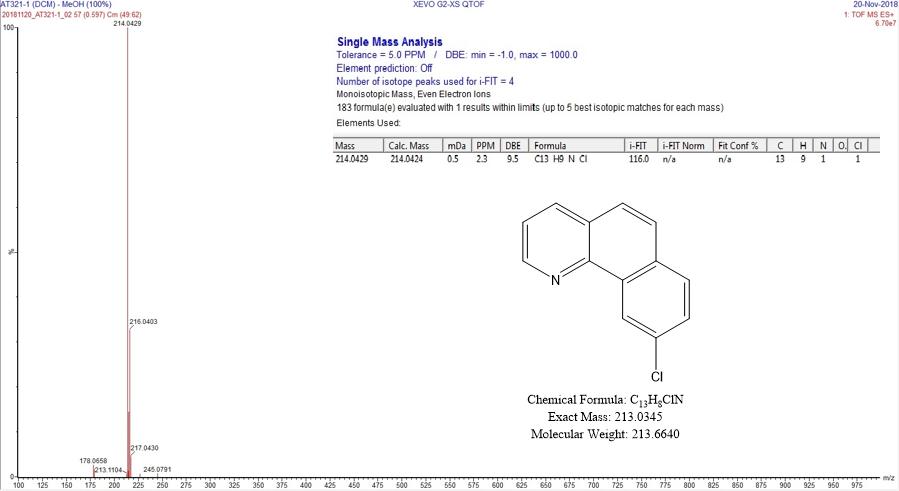
Accurate mass measurement of a compound derived from organic synthesis
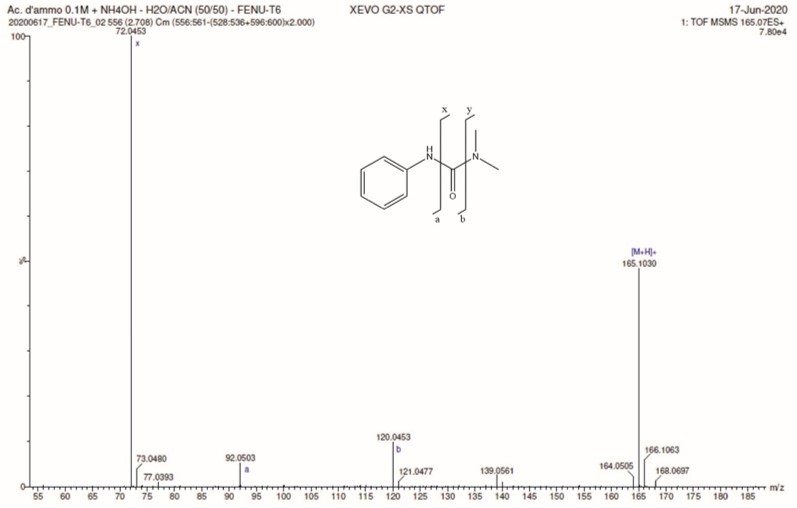
HRMS² of a pesticide
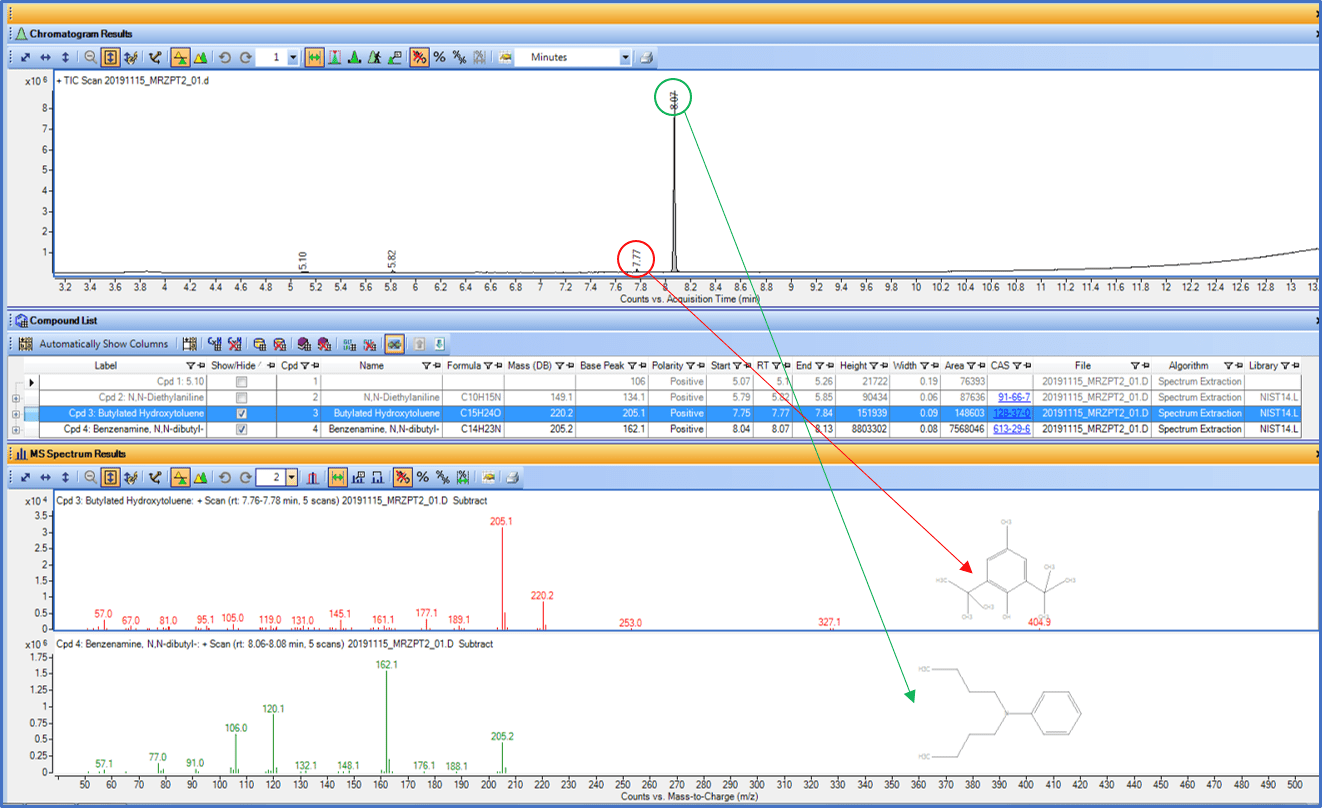
GC-MS characterization and purity determination of a compound derived from organic Synthesis
Characterization and Purity
In HPLC and UPLC, chromatographic systems are equipped with various detectors that enable the characterization of a wide variety of molecules in complex mixtures or the determination of relative purity. The detectors available on the platform are as follows: UV-Vis diode array, DEDL, fluorometer, polarimeter, and mass spectrometer.
- The UV-Vis detector is used to analyze compounds containing chromophores, whether pure or in mixtures.
- The light-scattering detector (ELSD), a nearly universal detector, allows for the analysis of all constituents present in a mixture regardless of their structure, provided they are not highly volatile. It also enables operation in gradient mode.
- The fluorometer detects organic compounds capable of emitting light via fluorescence, such as PAHs (Polycyclic Aromatic Hydrocarbons) or amino acids.
- The polarimeter is used to detect the optical isomers (+ and -) of chiral compounds, which have the ability to absorb circularly polarized light.
- The high-resolution mass spectrometer (Q-TOF) also provides the exact mass of the compounds along with proposed molecular formulas, whether for the parent compound or its fragments (if MS² analysis is performed).

UPLC/UV-Vis diode array chromatographic profile of a compound derived from organic synthesis
In GC, the instruments on the platform are equipped with either a flame ionization detector (FID) or a thermal conductivity detector (TCD), or are coupled with a single quadrupole mass spectrometer (GCMS).
They enable daily monitoring of reaction kinetics, characterization of molecules in complex mixtures, and quantification.

Chromatographic profile of a mixture of 16 free fatty acids and fatty acid methyl esters (FAMEs) by GC-FID
Quantitation
The platform offers its expertise in the quantification of small molecules derived from organic or biological sources. Its expertise is recognized for quantification in the fields of health and environmental chemistry.
Various calibration methods are available:
- External calibration
- Internal calibration
- Dosed additions
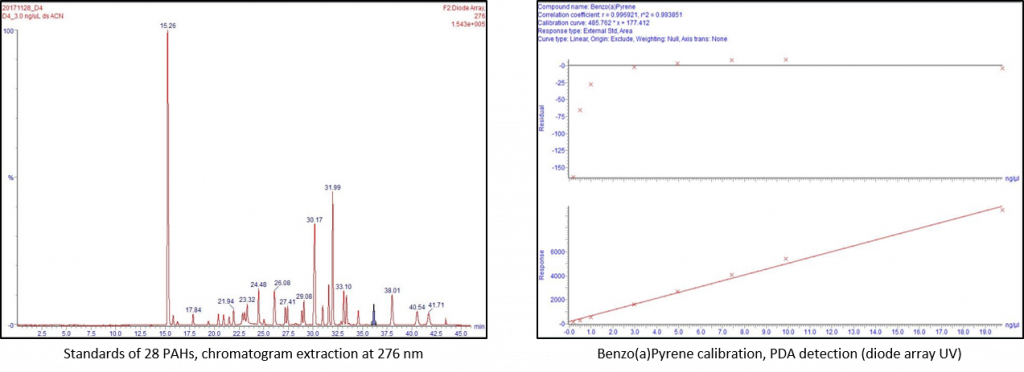
Example of quantitative analysis of small organic molecules
Quantitation of 28 PAHs extracted from bitumen fumes by HPLC-UV:
Quantitative kinetic monitoring of an enzymatic reaction:
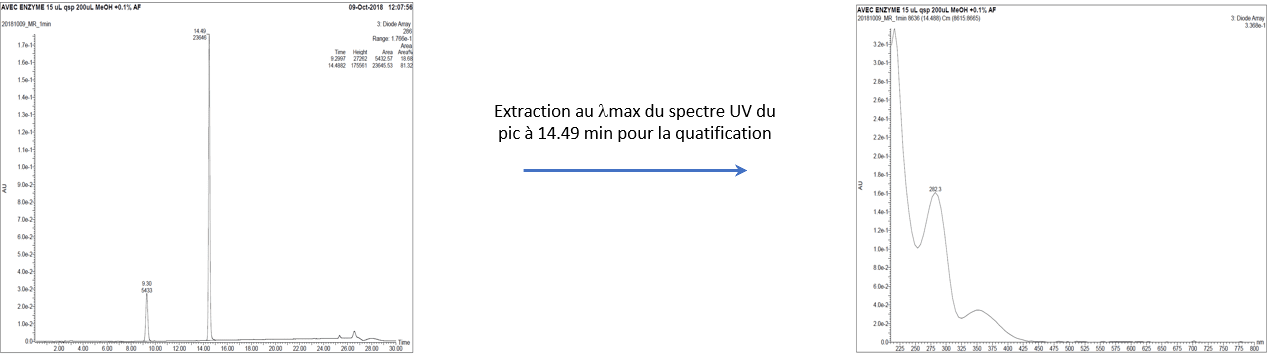
Extraction of the UV spectrum at ʎmax from the peak at 14.49 min for quantification
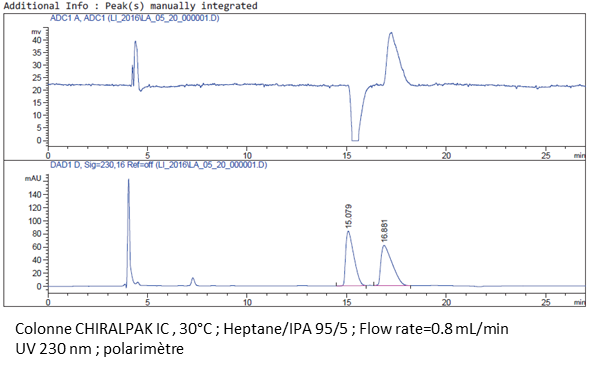
The platform offers expertise in the analysis of chiral compounds. It is equipped with an HPLC system featuring dual UV-Vis and polarimetric detection, enabling the determination of enantiomeric excess as well as the sign of the major enantiomer. It also offers nine chiral columns to screen on a wide range of molecules:
- CHIRALPAK AD-H, AS-H, IA, IB, IC ;
- CHIRALCEL OD-H, OJ-H ;
- Lux Amylose-2 ;
- Lux Cellulose-4.

The platform allows users, after obtaining a license, to independently access a wide range of GC instruments to perform daily kinetic monitoring of their reactions.
The instruments offered are equipped with columns specific to the analytes:
- Separation of nonpolar organic molecules
- Separation of free aminesAnalysis of ethylene and acetylene
- Analysis of hydrogen, carbon monoxide, and carbon dioxide
- Analysis of organic acids and fatty acids
The platform also offers an HPLC equipped with a single-wavelength UV-Vis detector for the characterization and purity measurement of molecules derived from organic synthesis.
View the relevant equipment (Scroll down to “Self-Service Tools")