Overview
Our group develops multivalent inhibitors that incorporate multiple ligands onto a single scaffold in order to optimize their binding affinity and inhibitory efficacy. Our main targets are virulence factors, particularly lectins and enzymes, expressed by bacteria of the gut microbiota. In parallel, we are developing new bioconjugation strategies aimed at modifying the surfaces of viral and cellular vectors for applications in gene therapy and cancer immunotherapy. Our innovative and chemoselective approaches enable the specific targeting of selected amino acids on surface proteins, thereby optimizing the functionalization of biomolecules.

Research
1. Multivalency and glycosidases
Multivalent ligands are extensively used to inhibit carbohydrate-binding proteins (lectins). We, and others have transferred this concept to carbohydrate-processing enzymes (glycosidases), by synthesizing and showing that multivalent transition-state inhibitors could strongly inhibit enzymatic activities.

Selected recent articles
1-Targeting Sialic Acid Catabolism with Polyvalent Sialidase Inhibitors to Mitigate Bacterial Inflammation in the gut.
Baudin Marie, M.; Oblette, Z.; Loquet, D.; Scalabrini, M.; Kavanaugh, D.; Deniaud, D.; Bessonnet, T.; Amzil, N.; Elgarrab, A.; Grandjean, C.; Gonnot, C.; Boeda, F.; Fontaine, L.; Montembault, V.; Daligault, F.; Barnich, N.; Sivignon, A.*; Gouin, S.G.* Bioorg. Chem. 2026, 168, 109283.

Inflammatory bowel diseases (IBD) are associated with intestinal dysbiosis and the expansion of pro-inflammatory Enterobacteriaceae, a process fueled by microbial degradation of mucins and the release of sialic acids. Targeting sialic acid catabolism therefore represents a promising anti-virulence strategy. We developed three (neo)glycopolymers displaying sialic acid analogues as multivalent inhibitors of bacterial sialidases (SA) and sialate O-acetylesterases (SIAE), key enzymes involved in mucin desialylation. Among them, the transition-state analogue glycopolymer poly-S-Neu5Ac2en100 showed exceptional potency, inhibiting Bacteroides sialidases at subnanomolar concentrations and markedly outperforming monovalent inhibitors. It efficiently prevented mucin desialylation and strongly reduced the growth of adherent-invasive Escherichia coli (AIEC), a pathobiont linked to Crohn’s disease.
2- Multivalent inhibition of the Aspergillus fumigatus KDNase.
Scalabrini M.; Loquet D.; Rochard C.; Baudin-Marie M ; Assailly C.; Brissonnet Y. ; Daligault F. ; Saumonneau A. ; Lambert A. ; Grandjean C. ; Deniaud D. ; Lottin P. ; Pascual S. ; Fontaine L. ; Balloy V. ; Gouin S.G. * Org. Biomol. Chem., 2024, 22, 5783-5789.

Aspergillus fumigatus is an opportunistic fungal pathogen responsible for severe infections in immunocompromised patients. Recently, AfKDNAse, an exoglycosidase that hydrolyzes the rare sialic acid analogue KDN, was identified and implicated in fungal cell wall organization and virulence. To investigate its biological role and assess its potential as an antivirulence target, we developed AfKDNAse inhibitors based on hydrolytically stable thio-KDN motifs. Both heterodi-KDN compounds and a multivalent glycopolymer displaying an average of 54 KDN units were synthesized. While the heterodi-KDN inhibitors showed moderate activity, the polymeric inhibitor exhibited markedly enhanced potency (IC50 = 1.5 ± 0.4 µM), representing over a 1,000-fold improvement compared with a monovalent KDN reference and constituting, to our knowledge, the most potent synthetic KDNase inhibitor reported to date. Importantly, this multivalent inhibitor significantly reduced A. fumigatus filamentation at micromolar concentrations, highlighting multivalency as an effective strategy for KDNase inhibition and supporting AfKDNAse as a promising antivirulence target.
3-Polyvalent Transition-State Analogues of Sialyl Substrates Strongly Inhibit Bacterial Sialidases.
Assailly, C.; Bridot, C.; Saumonneau, A.; Lottin, P.; Roubinet, B.; Krammer, E-M.; François, F.; Vena, F.; Landemarre, L.; Alvarez Dorta, D.; Deniaud, D.; Grandjean, C.; Tellier, C.; Pascual, S.; Montembault, V.; Fontaine, L.; Daligault, F.; Bouckaert, J.; Gouin, S.G.* Chem. Eur. J. 2021, 27, 3142-3150.

Bacterial sialidases are key virulence factors expressed by several human pathogens, including Streptococcus pneumoniae, Vibrio cholerae, and Clostridium perfringens. To develop highly potent inhibitors, we designed multivalent compounds based on the transition-state analogue DANA (2-deoxy-2,3-didehydro-N-acetylneuraminic acid). Among them, a DANA-functionalized polymer (Poly-DANA) inhibited sialidases from S. pneumoniae (NanA) and Bacteroides thetaiotaomicron (BtSA) with exceptional potency, reaching picomolar to low nanomolar activity. Each DANA unit displayed more than a 10,000-fold enhancement in inhibitory efficacy compared with the monovalent analogue, representing one of the strongest multivalent effects reported for enzyme inhibition. Mechanistic studies showed that this synergistic effect originates from interactions with the catalytic domain rather than the carbohydrate-binding module. These findings establish multivalency as a powerful strategy for sialidase inhibition and open new opportunities for targeting other sialidase families, including viral, parasitic, and human enzymes.
2. Click electrochemistry for the chemoselective labelling of tyrosines
We developed an electrochemical bioconjugation method that allows the specific grafting of a chemical anchor onto the tyrosine residues of proteins by applying an electrical potential difference in solution (J. Amer. Chem. Soc., 2018, 140, 17120). This electro-bioconjugation reaction occurs within minutes, enabling the functionalization of viral vectors, bacteria, and cells without compromising their viability.
1-Click-Electrochemical Conjugation of Complex Carbohydrates to Protein and Cell Surfaces.
Scalabrini, M.; Loquet, D.; Richard-Millot, E.; Clémenceau, B.; Ollier, J.; Pavageau, K.; Bouzelha, M.; Fort, S.; Retière, C.; Depienne, S.; Cloteau, C.; Lambert, A.; Croyal, M.; Deniaud, D.; Mével, M.*; Gouin, S.G.* ChemRxiv. 04 May 2026. DOI: https://doi.org/10.26434/chemrxiv.15002711/v1.

Carbohydrate conjugation to proteins and cell surfaces remains challenging despite the central role of glycans in biology and medicine. We developed a versatile electrochemical strategy for the rapid and chemoselective grafting of complex carbohydrates onto proteins and living cells. A bifunctional N-methylluminol (NML) linker enabled the attachment of unprotected glycans at their reducing end and their subsequent electrobioconjugation to exposed tyrosine residues through mild electrooxidation. This approach proceeded efficiently in aqueous conditions while preserving the integrity and biological activity of both protein and glycan partners. A diverse range of glycans, including sialylated and tumor-associated epitopes, were successfully installed on proteins with retained lectin recognition. Applied to cell surfaces, the method enabled high-density carbohydrate display within minutes without affecting cell viability. In particular, immune cell engineering with sialylated ligands allowed selective engagement of SIGLEC-2 on B cells and lymphoma cells. This electrochemical pseudo-glycosylation platform provides a powerful tool for studying glycan functions and developing carbohydrate-based applications in immunology, oncology, and vaccine design.
2- Click-electrochemistry for the rapid labeling of virus, bacteria and cell surfaces.
Depienne, S.; Bouzelha, M.; Courtois, E.; Pavageau, K.; Lalys, P-A.; Marchand, M.; Alvarez-Dorta, D.; Nedellec, S.; Marin-Fernandez, L.; Grandjean, C.; Boujtita, M.; Deniaud, D.; Mével, M.*; Gouin,S.G.* 2023. Nat. Commun, 2023, 14, 5122.

Surface engineering of viruses, bacteria, and cells is a valuable strategy for studying membrane biology and developing advanced gene and cell therapies. We developed a rapid and versatile electrochemical bioconjugation method based on N-methylluminol (NML), a tyrosine-selective anchoring group activated by electrooxidation. By applying a mild electric potential, NML derivatives bearing azide, biotin, or carbohydrate functionalities were directly grafted onto the surfaces of recombinant adeno-associated viruses (rAAV2), Gram-positive and Gram-negative bacteria, and mammalian cell lines. The modification was achieved within minutes, without the need for metabolic incorporation, while preserving viral infectivity as well as bacterial and cellular viability. Because NML activation is strictly controlled by the applied current, the method provides precise temporal control over surface functionalization. This click-electrochemistry approach offers a broadly applicable and efficient platform for biomolecule conjugation across diverse biological systems.
3-Luminol anchors improve the electrochemical-tyrosine-click labelling of proteins.
Depienne, S.;* Alvarez-Dorta, D.; Croyal, M.; Temgoua, R.C.T.; Charlier, C.; Deniaud, D. ; Mével, M. ; Boujtita, M. ; Gouin, S.G.* Chem. Sci., 2021, 12, 15374-15381.

Selective modification of tyrosine residues is an attractive strategy in chemical biology to generate homogeneous protein conjugates while preserving biological activity. Here, we compared electrochemical tyrosine bioconjugation (eY-click) using phenylurazole (PhUr), N-methylphenylurazole (NMePhUr), and N-methylluminol (NMeLum) derivatives. Among them, NMeLum showed the highest performance, enabling complete tyrosine-selective labeling of peptides and diverse proteins under mild electrochemical conditions, without detectable side reactions on other nucleophilic residues. A broad range of biomolecules, including myoglobin, bovine serum albumin, enzymes, and the therapeutic antibody trastuzumab, were efficiently functionalized via a two-step eY-click/SPAAC strategy, while maintaining structural integrity and, in the case of trastuzumab, native binding affinity. Compared to PhUr-based methods, NMeLum-mediated eY-click exhibited faster kinetics, improved efficiency, and full chemoselectivity, and also enabled potential dual labeling of solvent-exposed tyrosines.
3. Glyco-coated virus for gene therapy
Our group also focuses on the development of novel, chemically modified adeno-associated virus (AAV) particles, with increased therapeutic efficiency, at the interface between vectorology and chemistry. AAVs are therapeutic platforms for the treatment of genetic diseases. Yet, past and ongoing clinical trials have highlighted some limitations, including the need for high doses to achieve therapeutic benefit, and the off-target transduction of various tissues. Chemically modified AAVs (ϕ-AAV) greatly decrease off-target effects, hence maximizing transduction in tissues of interest and improving the therapeutic index in AAV-based gene therapy. This was achieved by the covalent coupling of tissue-specific ligands on surface exposed residues of the AAV capsid. The main advantage of this chemistry oriented approach is to be able to functionalize AAV particles with various ligands which could not be genetically encoded, including polymers, sugars or lipids.

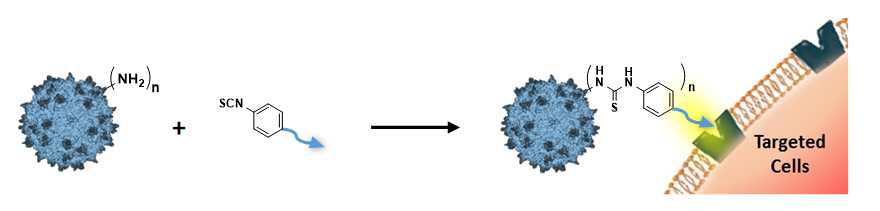
Project 1: Chemical modification of amino group on the surface of the capsid of AAV for hepatocytes targeting
These modifications are achieved by chemical coupling of a ligand by the formation of a thiourea functionality between the amino group of the capsid proteins and the reactive isothiocyanate motif incorporated into the ligand. This strategy does not require genetic engineering of the capsid sequence. The proof of concept was first evidenced using a fluorophore (FITC). Next, we coupled the N-acetylgalactosamine ligand onto the surface of the AAV capsid for asialoglycoprotein receptor-mediated hepatocyte-targeted delivery. Chemically-modified capsids showed reduced interactions with neutralizing antibodies. Taken together, our findings reveal the possibility of creating a specific engineered platform for targeting AAVs via chemical coupling.
Project 2: Chemical modification of tyrosine group on the surface of the capsid of AAV
This project investigate the possibility of re-targeting rAAV vectors via covalent linking of specific ligands to the tyrosine of AAV capsid by taking advantage of click-tyrosine chemical modification. Indeed it has been demonstrated that surface exposed tyrosine mutation on AAV2 capsids avoided degradation by the proteasome and resulted in high-efficiency transduction in human cells in vitro and murine hepatocytes in vivo. This “enhancer effect”, obtained after tyrosine mutation, has only been observed for this amino-acid and not after lysine mutation. These results demonstrated the prominent role of rAAV capsid tyrosine in cellular trafficking and transgene expression. This part will focus on the bioconjugaison of click tyrosine ligand, having specific targeting properties, on the capsid of AAV in one step. The proof of concept data has been protected by a patent filled in 2019.

Selected article
Chemical modification of the adeno-associated virus capsid to improve gene delivery Mathieu Mével,* Mohammed Bouzelha, Aurélien Leray, Simon Pacouret, Mickael Guilbaud, Magalie Penaud-Budloo, Dimitri Alvarez-Dorta, Laurence Dubreil, Sébastien G. Gouin, Jean Philippe Combal, Mirja Hommel, Gloria Gonzalez-Aseguinolaza, Véronique Blouin, Philippe Moullier, Oumeya Adjali, David Deniaud,* Eduard Ayuso.* Chem. Sci. 2019, 140, 17120.
Gene delivery vectors based on adeno-associated virus (AAV) are highly promising due to several desirable features of this parent virus, including a lack of pathogenicity, efficient infection of dividing and non-dividing cells and sustained maintenance of the viral genome. However, the conclusion from clinical data using these vectors is that there is a need to develop new AAVs with a higher transduction efficiency and specificity for relevant target tissues. To overcome these limitations, we chemically modified the surface of the capsid of AAV vectors. These modifications were achieved by chemical coupling of a ligand by the formation of a thiourea functionality between the amino group of the capsid proteins and the reactive isothiocyanate motif incorporated into the ligand. This strategy does not require genetic engineering of the capsid sequence. The proof of concept was first evidenced using a fluorophore (FITC). Next, we coupled the N-acetylgalactosamine ligand onto the surface of the AAV capsid for asialoglycoprotein receptor-mediated hepatocyte-targeted delivery. Chemically-modified capsids also showed reduced interactions with neutralizing antibodies. Taken together, our findings reveal the possibility of creating a specific engineered platform for targeting AAVs via chemical coupling. 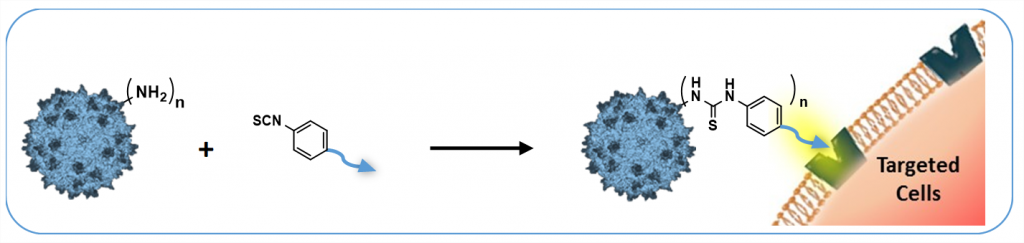
Team
Staff







PhD students and post-doc

Héloise Delépée (PhD 2023-2026)

Ankita Chandra (Postdoctoral Researcher 2026-)

Marc Borit-Guichot (Postdoctoral researcher 2026-)

Mathieu Scalabrini (Postdoctoral researcher 2026-)

Léa Cheneau (PhD 2026-)
Financials