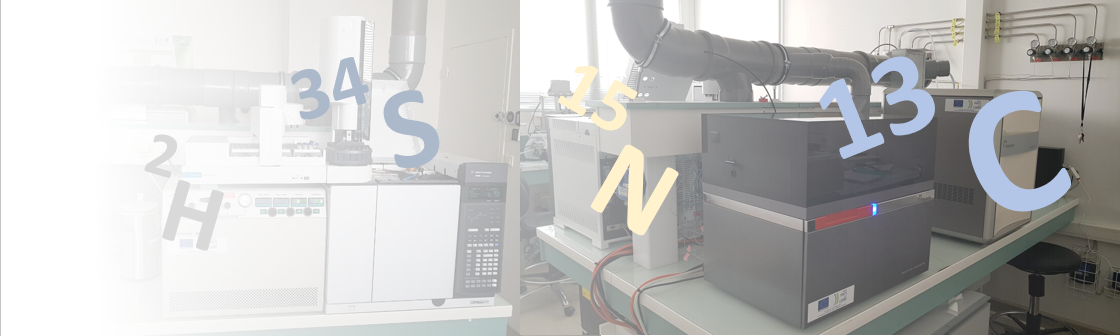
Isotope Platform

Supported by :

The Isotope Platform in the Pays de la Loire (PLI) is the regional infrastructure for isotope analysis created in 2021 in the framework of the Program "Infrastructure de recherche ligérienne" launched by the Pays de la Loire region  in collaboration with the European Commission.

The PLI brings together complementary analytical tools (equipment, analytical techniques, software) and complementary application‑focused expertise: isotope in environment, authentication, and nutrition–health at CEISAM-Nantes (UMR 6230 CNRS), and isotope in plant biology and agronomy at IRHS-Angers (UMR 1345 INRAe).

The PLI is integrated into the Corsaire platform, the metabolomics-fluxomics division of Biogenouest. It is also worth noting that, at the international level, the PLI maintains close relationships with isotope platforms abroad: the Institute of Science Tokyo (Japan), Caltech (USA), and the Australian National University (Australia). The Nantes site is also part of MétaboHUB, the national excellence infrastructure for metabolomics-fluxomics.

PLI missions

The PLI aims to provide cutting‑edge technological tools and services in isotope analysis and isotopomic approaches (high‑throughput analysis of isotopic profiles and signatures) to academic research teams and industrial partners in the fields of authentication, plant sciences, health, nutrition, ecology, environment, and forensics. Its ambition is to develop advanced isotopomic methods using isotope ratio mass spectrometry (IRMS) and quantitative nuclear magnetic resonance (qNMR) to address the technological challenges encountered in these areas.

The need to explain and optimize biological or chemical processes has led to a growing demand for large‑scale compound‑specific (CSIA) and/or position‑specific (PSIA) isotope analyses.

Service offering

Analytical services

  • Bulk isotope analyses (¹³C, ¹⁵N, ²H, 18O, ³⁴S)
  • Compound-specific isotope analyses (13C and 15N) using GC-C-IRMS (amino acids, fatty acids, sugars, organic acids)
  • Position-specific isotope analyses (13C and 2H) using NMR
  • Metabolomic analyses using GC-MS with or without MS/MS fragmentation

R&D services and method development

  • Development of new isotopic methods to meet specific needs
  • Scientific collaboration on the design and optimization of protocols
  • Interpretation of isotopic data and guidance for industrial applications

Training and skills transfer

  • Training in isotope analysis and equipment handling
  • Customized training sessions tailored to the users’ level (academic or industrial)
  • Methodological support for integrating isotopic data into industrial or research projects

Method transfer to implement position‑specific isotope analysis by NMR at a client’s facility

Available equipment

Nantes site: 7 instruments

EA-IRMS Thermo Fischer Scientific

Bulk analysis (¹⁵N and ¹³C)

GC-C-IRMS Thermo Fischer Scientific

Compound-specific analysis (¹⁵N and ¹³C)
Isotopic profiling of fatty acids

Acquisition: 2007
Planned replacement: 2026

GC-C-IRMS Elementar

Compound-specific analysis (¹⁵N and ¹³C)
Isotopic profiling of amino acids

Acquisition: 2022
Planned replacement: 2042

ISOFLOW Elementar

13C and 18O analysis of air CO2, exhaled gas and carbonates

Acquisition: 2022
Planned replacement: 2042

Preparative HPLC Shimadzu

Equipped with an autosampler, a fraction collector, an ELSD detector, and a diode‑array UV detector

Acquisition: 2021
Planned replacement: 2041

400 MHz NMR QUAD SYSTEMS

1H, 2H and 13C spectrum
Metabolomic profiling and position-specific isotope analysis

Acquisition: 2023
Planned replacement: 2043

Microbalance XP6 Automated-S

METTLER TOLEDO

Precision 10-3 mg
Maximum capacity 6,1 g

Acquisition: 2010
Planned replacement: 2030

Precision balance PXD235D

OHAUS Pioneer

Precision 10-2 mg, maximum capacity 82 g
and precision 10-1 mg, maximum capacity 220 g

Acquisition: 2018
Planned replacement: 2038

Angers site: 6 instruments

EA-IRMS

Elementar

Bulk analysis (¹³C, ²H, 18O, 15N and ³⁴S )

Acquisition: 2020
Planned replacement: 2040

GC-C-IRMS

Elementar

Compound-specific analysis (¹³C and 15N)
Organic acids, sugars and amino acids profiling

Acquisition: 2020
Planned replacement: 2040

ISOFLOW

Elementar

13C and 18O analysis of air CO2, exhaled gas and carbonates

Acquisition : 2020
Planned replacement: 2040

GC-MS (Orbitrap)

Thermo Fischer Scientific

Metabolomic analyses with or without MS/MS fragmentation

Acquisition: 2019
Planned replacement: 2039

RMN 600 MHz

Bruker

Metabolomic profiling and 13C position-specific isotope analysis

Acquisition: 2024
Planned replacement: 2044

Microbalance WXTS3DU

Mettler Toledo

Precision 10-3 mg
Maximum capacity 3.2 g

Acquisition: 2020
Planned replacement: 2040

Access for users

Access conditions

The PLI is open to academic and industrial users, both internal and external to the two sites (Nantes and Angers). Access is granted based on validated scientific projects, with prioritization depending on equipment availability and scientific relevance.

Contact procedure:

Requests are centralized and evaluated by the scientific and technical managers to define the analysis plan and assess technical feasibility.

User support

Each project benefits from personalized support provided by the technical and scientific managers:

  • Assessment of the request and selection of the appropriate method
  • Sample follow‑up and scheduling of analyses
  • Interpretation of results and scientific discussion
  • Training in instrument use and good analytical practices
  • Possible implementation of collaborative R&D projects
This organisation guarantees a response within 10 working days, high‑quality follow‑up, and effective appropriation of results by users.