LUMOMAT University Research School (EUR)

The LUMOMAT program, a recipient of the France 2030 Investments for the Future Program and designated a University Research School by the National Research Agency, is led by the University of Angers in collaboration with Nantes University and the University of Rennes.
The LUMOMAT Research University involves four CNRS–University Joint Units:
- the Moltech-Anjou laboratory (University of Angers)
- the Rennes Institute of Chemical Sciences (ISCR) (University of Rennes)
- CEISAM (Nantes University)
- the Jean Rouxel Institute of Materials in Nantes (Nantes University).
LUMOMAT—LUmière MOlécules MATière—brings together scientific expertise focused on molecular materials for electronics and photonics. The EUR covers the entire value chain, from molecular design to device fabrication, with numerous applications in three main fields:
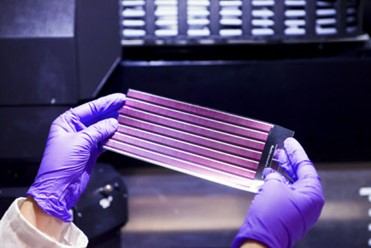
- energy (organic solar cells, artificial photosynthesis, OLEDs)
- health and the environment (probes and sensors)
- information storage and transmission (nanostructured systems and imaging).
Modeled after Graduate Schools, the EUR ensures a seamless progression from Bachelor’s to Master’s to Doctoral degrees while meeting international standards of excellence. It trains chemists with multidisciplinary skills who are capable of designing, developing, and then characterizing molecular materials from a physicochemical perspective, as well as integrating them into photonic and/or electronic devices.
The LUMOMAT University Research School (EUR) program consists of:
- A Bachelor’s degree integrated into the Master’s in Engineering (CMI) program, with a specialization in Chemistry (LUMOMAT)
- A Master’s degree in organic chemistry, offered for over 10 years, taught in English, and open to work-study programs that encourage international experiences. Master’s Year 1: Nantes or Rennes; Master’s Year 2: Angers
- A Ph.D. program funded or accredited by the LUMOMAT program, which provides access to financial aid for mobility, a network, and events (scientific conferences organized by LUMOMAT).
It also issues calls for proposals to fund research theses and postdoctoral positions. A scientific committee composed of the four directors of the partner laboratories and three scientific leaders from the three universities oversees the program’s scientific policy. Its role is to:
- manage calls for scientific proposals
- monitor funded projects
- decide on the allocation of funding for doctoral students
EUR LUMOMAT has a strong international focus, with partnerships with universities and laboratories around the world, including two dual-degree programs (Taras Shevchenko National University in Kyiv, Ukraine, and the Lebanese University in Beirut, Lebanon) and an internal International Scientific Council.