
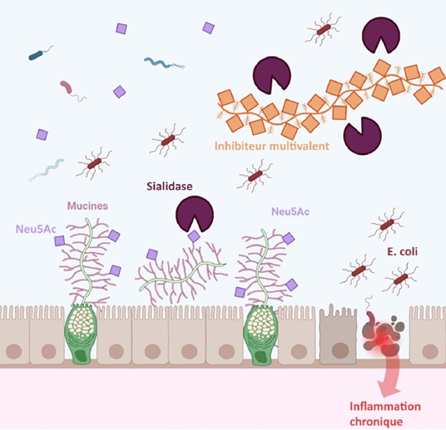
Some enzymes produced by the gut microbiota attack the sugars that protect the intestine. A research team at the CEISAM laboratory is developing molecules capable of inhibiting these enzymes as potential treatments for inflammatory bowel diseases.
The team is tackling a challenge as old as modern medicine. “We are developing new approaches to treat bacterial infections, explains Sébastien Gouin, CNRS Research Director. At present, these diseases are still primarily treated with antibiotics, despite the growing emergence of antibiotic resistance. It is therefore essential to develop alternative treatment strategies against which bacteria would be less likely to develop resistance mechanisms.”
The researchers are exploring an alternative strategy to limit the development of pathogenic E. coli in the gut, in which mucins play an essential role. Mucins are the main component of intestinal mucus and play a vital role in regulation and protection. These gel-forming glycoproteins expose a family of sugars on their surface known as sialic acids, predominantly N-acetylneuraminic acid (Neu5Ac). Certain bacterial species belonging to the gut microbiota produce sialidases, enzymes capable of cleaving Neu5Ac from the surface of the mucus.
The researchers have developed powerful inhibitors of bacterial sialidases. The strategy used, known as a multivalent approach, consists of grafting several inhibitor motifs onto a common chemical scaffold, thereby greatly enhancing their effects. The most effective inhibitors were designed using peptides modified by an electrochemical method (eY-click) developed by the group, together with polymers synthesized at the Institut des Molécules et Matériaux du Mans and subsequently post-functionalized using click chemistry.
Would you like to find out more? Read the full Focus Science article published on the national CNRS Le Journal blog: https://lejournal.cnrs.fr/nos-blogs/focus-sciences/des-antibacteriens-pour-limiter-les-syndromes-inflammatoires-de-lintestin.